
Designing a program that helps young adults from foster homes to successfully become independent
Komerční Banka Corporate Foundation
Introduction
When our team first met with Nadace KB, the team was honest about their situation:
"We want to help children from foster homes, but we're spread thin and don't know which direction to take."
Historically, their activities ranged from planting trees to helping single mothers. Everyone cared, but energy was scattered. The challenge was to help them find a clear, sustainable direction and design a programme that would make a tangible social impact, not just another grant cycle.
Context and Challenge
Foundation board members were intrigued by the idea of supporting professional integration of children growing up in foster homes. But once we began field research, it became clear that the problem ran much deeper.
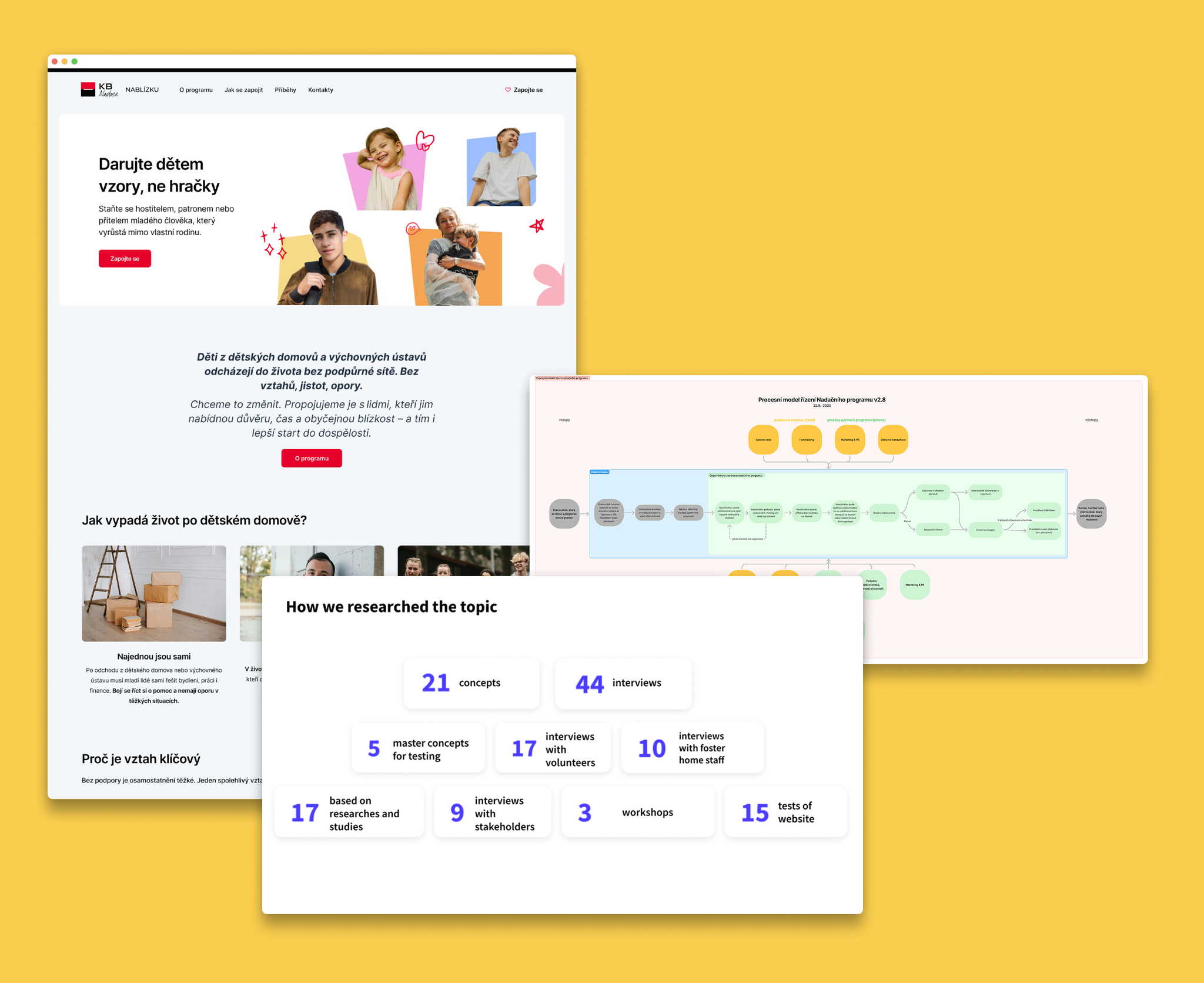
We interviewed directors of children's homes, psychologists, social workers, and experts from NGOs and halfway houses. They shared stories that shifted the perspective entirely.
These young people don't fail because they lack skills. They fail because they have no one to call when things go wrong.
For many, leaving a children's home means facing adult life alone — without family, without role models, without anyone to ask for help. The core issue wasn't employability. It was relationships and the absence of a personal safety net.
Research and Insights
The fieldwork revealed a striking diversity among children's homes: their quality and culture depend heavily on the director's personal values. Some homes nurture university students and athletes; others struggle with basic safety.
We mapped problems and opportunities and identified three groups:
1. Transition to independence: emotional and practical unpreparedness for adult life.
2. Systemic issues: fragmented cooperation between state, NGOs, and homes.
3. Relationships: the missing layer of stable, trustworthy adults.
This third theme became the backbone of the future programme.
A simple reflection exercise helped the team and board members of foundation understand the importance of relationships in our lives:
"Think about everything your parents did for you between 19 and 25 — advice with first job, support in financial issues, a place to sleep, a phone call when things fell apart. Now imagine not having that."
— me
This approach reframed the entire discussion.
Ideation and Concept Development
For the ideation workshop, we invited both team of foundation and young adult who grew up in foster homes. We used this opportunity to validate our data. Instead of abstract brainstorming, we created solution concepts that tackled specific problems.
It was crucial to understand the strengths and weaknesses of the KB Group. One of the main weakness of the foundation was that their team consisted of three people. The main strength was that the group had six thousand engaged employees in Czechia.
We tested concepts directly with directors of children's homes and NGOs. The strongest direction combined three insights:
— Meaningful help doesn't come from one-off donations but from consistent personal relationships both with children and with directors.
— KB has a network of thousands of employees who want to volunteer but need a safe, guided way to do it.
— The bank's communication strength and credibility can help normalize the topic nationally.
Out of that came a unifying vision:
"Every young person who wants to can have a trusted patron, should be able to have such a person."
The foundation would not build new infrastructure but support and connect existing organizations that are already creating long-term patronage relationships.
Outcome and Impact
Together with Nadace KB, we formulated the mission, vision, and volunteer journey, which we validated with domain experts.
The result is a clear, credible direction that leverages the bank's human capital, its employees, while addressing a real systemic gap.
For the KB team, this project marked a shift from philanthropic fragmentation to purposeful focus.
For me personally, it was a reminder that real change often starts not with money, but with someone who stays in touch when life gets complicated.