
Designing a service that enables households to take part in balancing the grid
E.ON Czechia
Challenge
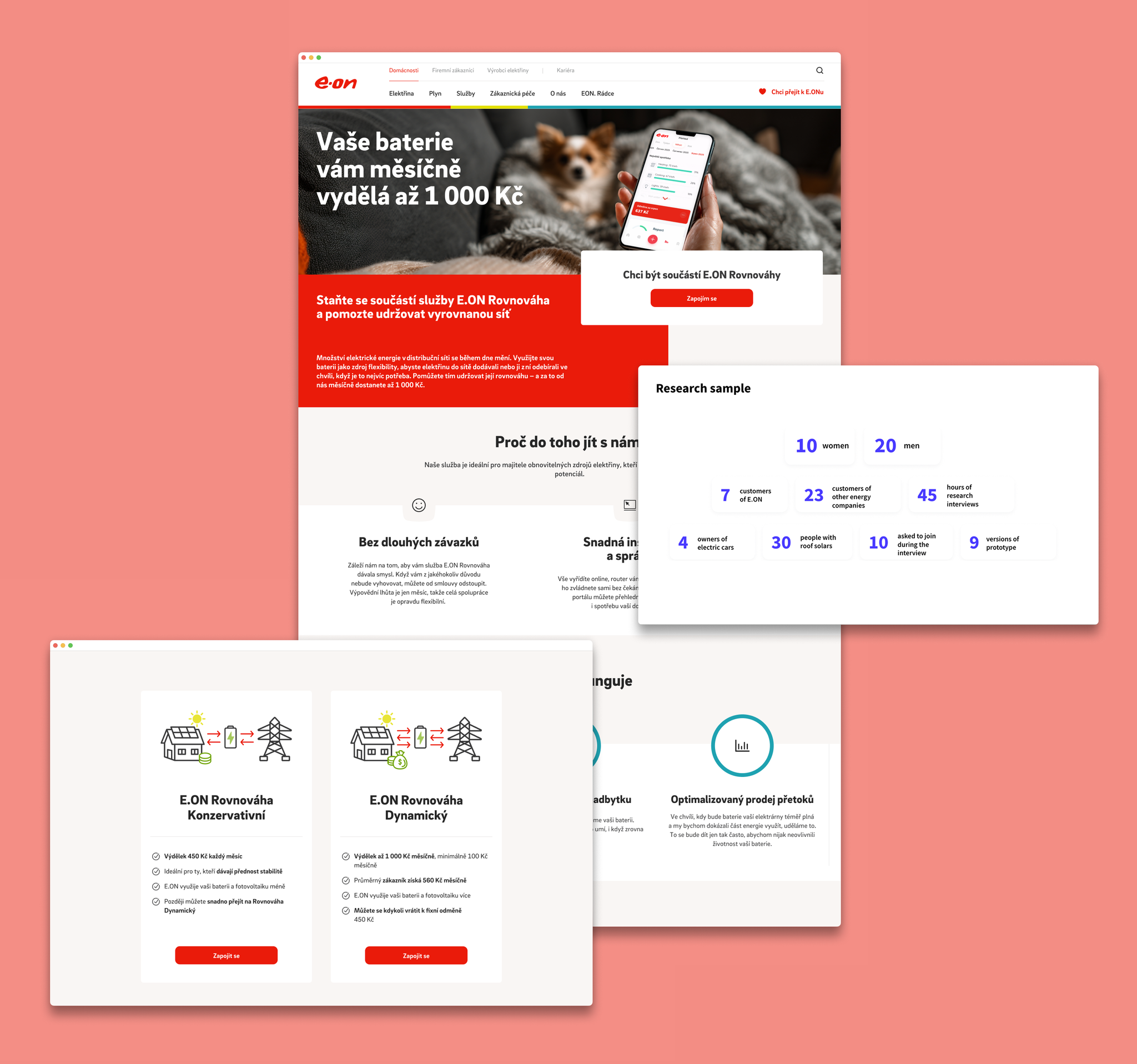
E.ON Czechia approached us with an idea: what if households could help balance the national energy grid by sharing part of the capacity of their home batteries? The goal was to create a product that would make participation on balancing the grid desirable and easy to understand. This innovation would suport the broader integration of renewable sources.
My role was to lead the design process. I accepted the project after the early research phase was finished and my goal was to design a clear, testable service concept and market proposition.
Context and Challenge
As more renewable sources enter the grid, energy flow becomes less predictable. E.ON wanted to pilot a service that would connect their central system with customers' home batteries. The system could then store surplus energy and draw from it when needed.
The challenge wasn't the technology. The challenge was trust.
How do you convince households to let the energy provider remotely manage their battery without fear of losing control, damaging their equipment, or being used unfairly?
Our approach
Our key insight was that user personas were very diverse. They ranged from enthusiasts who are eager to implement every innovation, through indifferent majority, to skeptics.
We started by mapping user personas to adoption curve. This enabled us to focus on specific needs of a narrow customer group. Based our decision on the knowledge of a current customer group of E.ON. We focused on the early majority — people open to innovation but cautious about risk.
We co-designed the first low-fidelity prototype: a landing page that explained the service, its benefits, and boundaries of control. Then we tested and iterated repeatedly rewriting copy, simplifying diagrams, and adding transparency.
Questions that guided our design were simple:
→ What exactly happens to my battery?
→ How much control do I give up?
→ How do I get the reward?
Key findings
Transparency beats persuasion.
Users didn't need grand promises. They needed concrete data. For example, how often the battery would be activated or by how many percent. We used historical activation examples to give the service real grounding without making any promises that E.ON would later have to regret.
Rewards should feel tangible.
Integrating the financial reward into regular billing felt invisible. Together with E.ON's accounting team, we found a way to send the money directly to bank account. This proved to be a small design choice that made participation feel real and noticeable.
Endings matter.
We also looked at off-boarding. Many companies make this intentionally hard; we made it simple. The contract includes a clear withdrawal form and step-by-step process.
Outcome and Impact
The result was E.ON Rovnováha, a pilot service that allows households with solar panels and batteries to earn money by helping E.ON stabilize the grid.
For E.ON, the service created a scalable model for distributed flexibility. For customers, it offered a way to participate in the energy transition without sacrificing comfort or autonomy.
Our team supported the E.ON team throughout the launch. Thanks to quantitative data from live service and mystery shopping our team was able to iteratively improve the conversion rates for different steps in customer journey.