
Building a digital health tool for gender diverse people on HRT
Align Nutrition
Context & Challenge
When a person starts hormone replacement therapy (HRT), their body changes in complex ways. Their metabolism shifts, their muscle mass changes, and their nutritional needs evolve. Yet, if they open almost any standard nutrition app today, they are forced to answer a rigid binary question: "Male" or "Female".
I discovered that standard algorithms rely on static equations that fail to account for the "metabolic ramp-up" of testosterone or the metabolic slowing of estrogen. This leaves millions of people relying on facebook groups and reddit forums.
The Challenge
The goal was to design a service that bridges the gap between clinical rigor and human empathy. The solution needed to be:
Medically Accurate: It had to follow complex endocrinology guidelines (like UCSF and WPATH) rather than generic fitness rules.
Psychologically Safe: It needed to support users who often struggle with body image, avoiding the "shame" triggers common in calorie trackers.
My Approach
I approached this problem with my dual background: using the mathematician's lens to fix the algorithm and the anthropologist's lens to understand the human need.
1. Deep Research: I analyzed the "shadow market" of advice on Reddit and Discord to understand what users need.
2. The "Gray Area" Algorithm: I defined a logic that interpolates caloric needs based on time on hormones (e.g., Month 3 vs. Month 12) rather than a binary switch. This prevents the "starvation shock" of sudden calorie drops.
3. Desirability: I've built and vibe coded a prototype that I'm currently testing with people on HRT medication.
The Solution: Align Nutrition
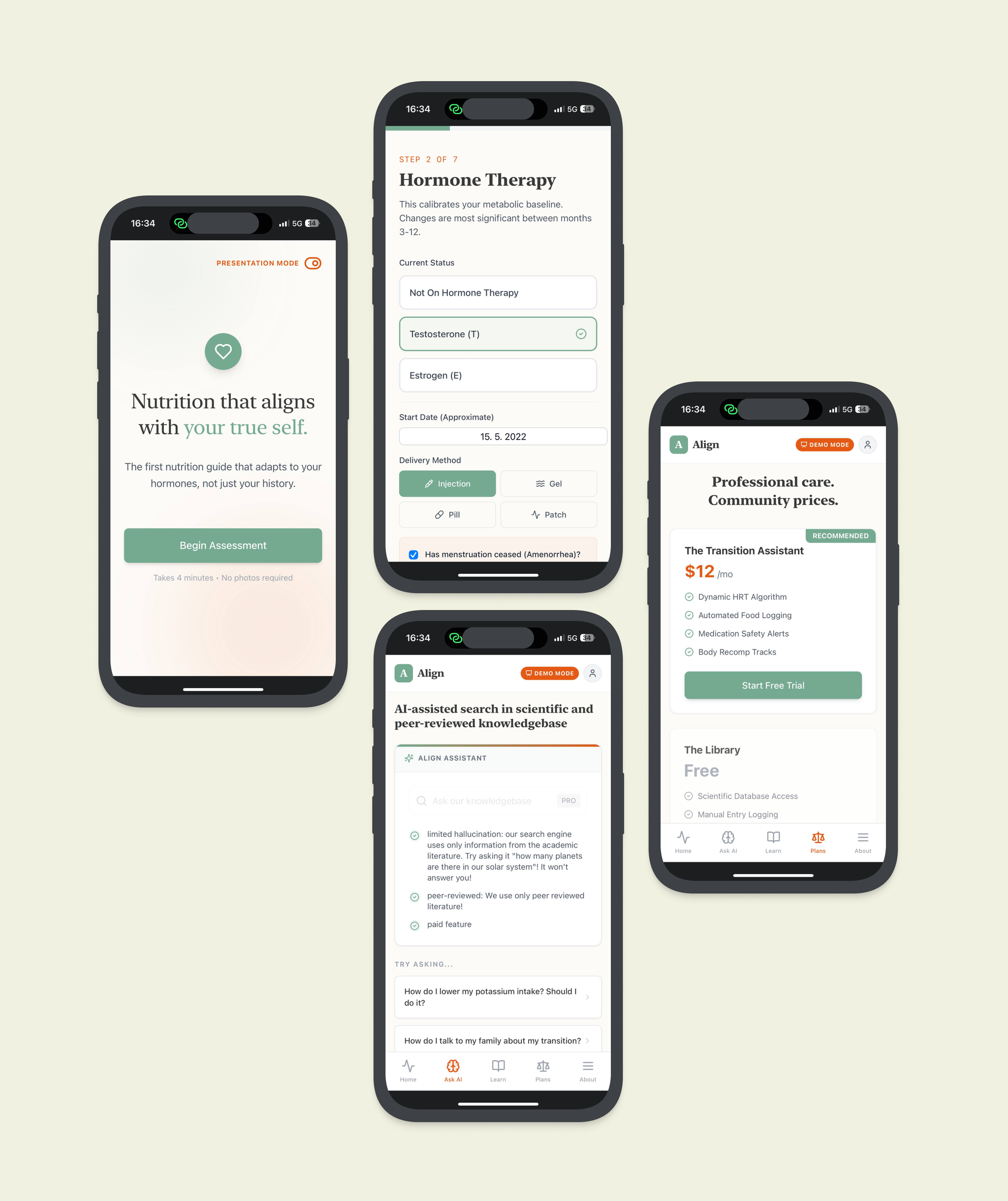
The result of this work is the concept for Align Nutrition, a digital companion for medical transition.
AI Agent: We've designed an AI agent that answers information sourced only from scientific articles (similar to NotebookLM by Google).
Recovery Mode: For users with a history of disordered eating, the app offers a mode that hides all numbers (calories/weight), focusing purely on nourishment and mood.
Translation Layer: We take dense medical papers and translate them into simple, 6th-grade level advice, helping users understand things like "Why am I so hungry on T?".
Prototype
We've used the rapid prototyping methodology to build multiple iterations of prototype to validate the problem and understand how does the target audience currently approach their situation.
This helped us define what should be the scope of MVP and what is the main customer pain we're trying to solve.
Next steps
We've already managed to get a support of Czech psychologists, sexologists and researchers that will help us design the solution.
We are currently applying for a grant at Danish Innovation agency and Czech Technical agency. Our team is also looking for a programmer that will develop first version of the solution.